Thinking About Switching to Flow Wrap for Minced Meat? Here’s What We’d Consider First
Packaging decisions used to be relatively straightforward.
A package needed to protect the product, run efficiently on the line and reach the retailer in good condition.
Today, minced meat producers are being asked to achieve much more. Retailers are pushing for packaging reduction. Sustainability targets are becoming increasingly ambitious. New legislation is reshaping packaging strategies. At the same time, consumers still expect the same freshness, product quality and shelf life they’ve always relied on.
It is no surprise that more producers are asking whether it’s time to rethink their packaging format.
In fact, according to Keith Gater, Product Manager of GreenChoice by Wipak®, one of the questions he’s hearing most frequently is remarkably simple:
“How do we change packaging format?”
For many minced meat manufacturers, that question leads directly to flow wrap packaging.
Why flow wrap is attracting attention
Flow wrap packaging has become one of the most talked-about developments in fresh meat packaging, and for good reason.
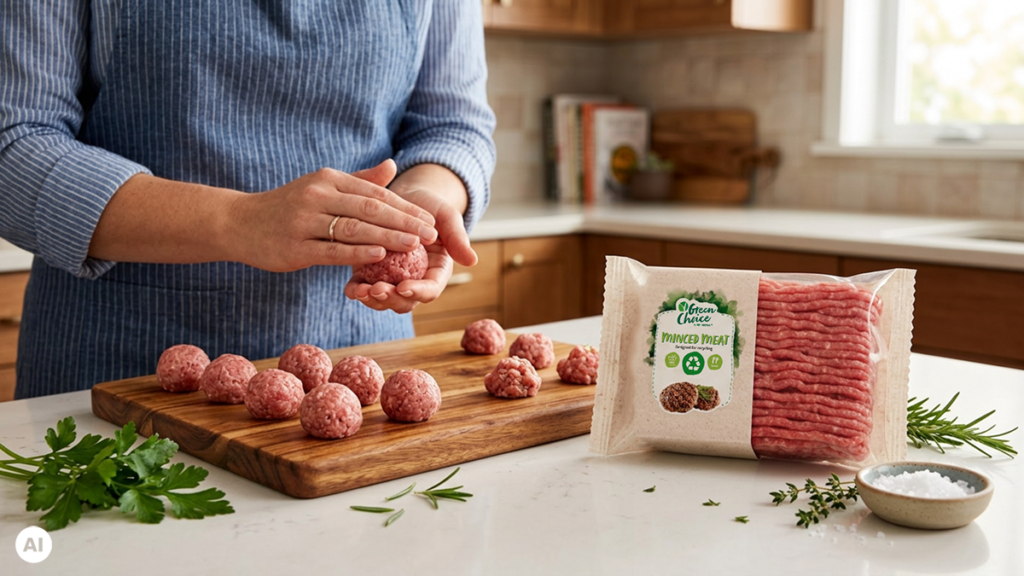
Unlike traditional tray-based formats, flow wrap removes the rigid tray and uses a flexible film structure to package the product. The result is a format that can significantly reduce packaging material while still delivering the protection fresh meat products require.
Industry data indicates that trayless flow wrap solutions can reduce plastic consumption by approximately 60 to 70 % compared with conventional tray-based minced meat packs. Industry sources also suggest that switching to flow wrap can dramatically reduce the transportation volume required for packaging materials.
However, reducing material use is only part of the story.
The real question is whether the packaging can continue to deliver the performance that fresh minced meat demands.
The challenge isn’t the pack. It’s the product.
One of the biggest misconceptions in packaging is that selecting a new format starts with choosing a material.
In reality, it starts with understanding the product.
Fresh minced meat places high demands on packaging. The material must support shelf life, maintain the desired atmosphere, preserve product appearance and withstand demanding production environments. The packaging also needs to maintain seal integrity despite the liquids and contamination commonly encountered in meat processing operations.
As Keith explained during a recent discussion on packaging selection:
“It all comes down to the requirements of the product, which then links to our pack format, which then takes you into material selection.”
That principle guides every successful minced meat packaging project.
Before discussing film specifications, we first look at the product characteristics, shelf-life objectives, machinery, distribution conditions and retailer expectations. These factors ultimately determine which packaging solution will perform best.
Freshness remains non-negotiable
Consumers may be increasingly interested in sustainability, but freshness remains the number one priority when purchasing meat.
Research shows that more than 65% of European consumers prioritise freshness when buying meat products.
This is where packaging plays a critical role.
Modified Atmosphere Packaging (MAP) has become a widely used technology in meat applications because it helps preserve freshness and maintain product quality. According to market research, MAP can extend the shelf life of fresh meat products by around 40% compared with conventional packaging methods.
For flow wrap packaging, this means selecting film structures with the appropriate barrier properties to maintain the desired atmosphere throughout the product’s shelf life.
The transition to a more sustainable packaging format should never come at the cost of product protection.
The packaging feature nobody notices until it fails
When customers ask about flow wrap, discussions often focus on recyclability, material reduction and legislation.
What receives less attention is often one of the most critical factors: seal performance.
Fresh minced meat applications are notoriously challenging. High packing speeds, liquid contamination and demanding production environments place significant pressure on package seals. If sealing performance is compromised, the consequences can include product waste, leakages and reduced shelf life.
That is why we place so much emphasis on validating seal performance before recommending a solution.
Our preferred BIAXOP ECO solutions for minced meat applications utilises our proprietary ZPP sealant technology because of its strong sealing performance and suitability for high-speed packing operations. Internal validation has shown particularly strong performance in helping minimise leakers while supporting efficient production.
For producers considering a move to recyclable mono-material structures, this type of operational reliability is every bit as important as sustainability performance.
Packaging decisions are becoming more complex
Today’s producers are balancing more variables than ever before.
Shelf life, line efficiency, recyclability, regulatory readiness, cost control and consumer expectations all need to be considered simultaneously.
As Keith notes, customer conversations increasingly focus on recyclable specifications, PPWR readiness, reducing complexity and changing packaging formats rather than simply selecting a packaging material.
This shift reflects a broader reality across the food industry. Packaging is no longer just a protective layer around a product. It has become a strategic business decision.
Looking ahead
Flow wrap packaging is gaining momentum because it addresses many of the challenges facing minced meat producers today.
It offers opportunities to reduce material use, improve logistics efficiency and support recyclability goals while still delivering the barrier performance, shelf life and production reliability required for fresh meat applications.
The key is recognising that there is no universal solution.
The best packaging choice is always the one that starts with the product and works backwards from there.
Or, as Keith put it, successful packaging selection begins with understanding the product requirements first, because those requirements ultimately determine the pack format and material choice.
For producers considering a move to flow wrap, that is often where the most valuable conversations begin.
Sources:
https://www.24chemicalresearch.com/reports/295739/europe-fresh-meat-packaging-market
https://www.ahdokkum.nl/van-bakje-naar-zakje/
https://packagingeurope.com/news/asda-vacuum-packs-beef-mince-line-in-60-less-plastic-than-trays/11002.article
https://www.interpack.com/en/Media_News/interpack_Magazin/FOOD_INDUSTRY_PACKAGING/