Designed for parents, built for brands
Why baby food pouches deliver convenience without compromise
Baby food is one of the most high-trust categories in the food industry. Parents expect absolute safety, simplicity and ease of use. At the same time, brands must deliver efficiency, differentiation and sustainability at scale. Packaging sits at the intersection of these expectations.
We design baby food pouches to meet both needs. Built for everyday parenting moments and engineered for modern production environments, flexible pouches offer a balanced solution that works from factory floor to feeding spoon.
What parents expect from baby food packaging
Parents are not choosing packaging for aesthetics alone. They are choosing it for reassurance.
From easy handling to hygiene and safety, packaging plays a direct role in how baby food is perceived and used.
- Parents increasingly value packaging that
- Is easy to open, reclose and use with one hand
- Supports on the go feeding without mess
- Has no sharp edges and is safe for small hands
- Preserves taste and nutritional value
- Matches clean label and sustainability expectations
Spouted baby food pouches are designed around these real use cases. Controlled dispensing reduces waste and improves feeding accuracy. Reclosable formats help manage portion sizes. Lightweight structures make transport and storage easier for carers and families.
Packaging does not replace good food but it influences how confidently parents choose and use it.
How pouch packaging supports baby food safety and quality
Safety is non-negotiable in baby food. Packaging must protect sensitive products without relying on additives or preservatives.
Our GreenChoice by Wipak® high barrier pouch structures are engineered to support
- Hot filling and pasteurisation
- Retort and HPP processing
- Long shelf life without aluminium layers
- Taste and nutritional protection throughout distribution
By combining barrier performance with mono material structures where possible, we support both food safety requirements and evolving sustainability expectations. Packaging becomes an enabling technology rather than a compromise.
This is especially critical as clean label baby food continues to grow across European markets.
Why brands are choosing pouches for baby food
For brands, packaging decisions extend far beyond the consumer moment. Efficiency, flexibility and consistency all matter.
Baby food pouches deliver measurable advantages across the value chain.
Production and filling efficiency
- Lightweight materials reduce handling complexity
- Formats compatible with modern filling technologies
- Reduced breakage compared to rigid packaging
- Optimised product to packaging ratio
Logistics and supply chain benefits
- Lower transport emissions due to reduced weight
- Space efficient formats improve pallet utilisation
- Less secondary packaging required
Branding and differentiation
- Large printable surfaces for clear communication
- Shaped and spouted formats increase shelf visibility
- Transparency options to showcase product quality
In competitive baby food markets, packaging must support speed to market while reinforcing brand trust. Pouches allow both.
Designed for sustainability without oversimplification
Sustainability in baby food packaging is complex. Materials, weight, processing and end of life outcomes all matter.
Flexible pouches typically require significantly less material than rigid alternatives and offer a high product to packaging ratio. Life cycle assessments consistently show lower carbon impact compared to glass jars, even when recyclability rates are considered.
Where legislation and infrastructure allow, mono material baby food pouches designed for recycling provide a future fit solution that aligns with European packaging regulation direction.
We believe sustainability must be practical, measurable and compatible with food safety. Pouch packaging supports all three.
Built to scale with the baby food market
The baby food category continues to grow, driven by clean label trends, evolving feeding habits and the need for convenience.
Pouch packaging supports innovation at scale
- Single serve and multipack formats
- Different spout sizes for age-appropriate feeding
- Shaped pouches for brand distinction
- Transparent or white structures depending on brand strategy
This flexibility allows brands to adapt quickly without redesigning their entire packaging system.
Packaging that works for people and business
Baby food packaging must perform in two worlds simultaneously. The everyday reality of parenting and the operational reality of food production.
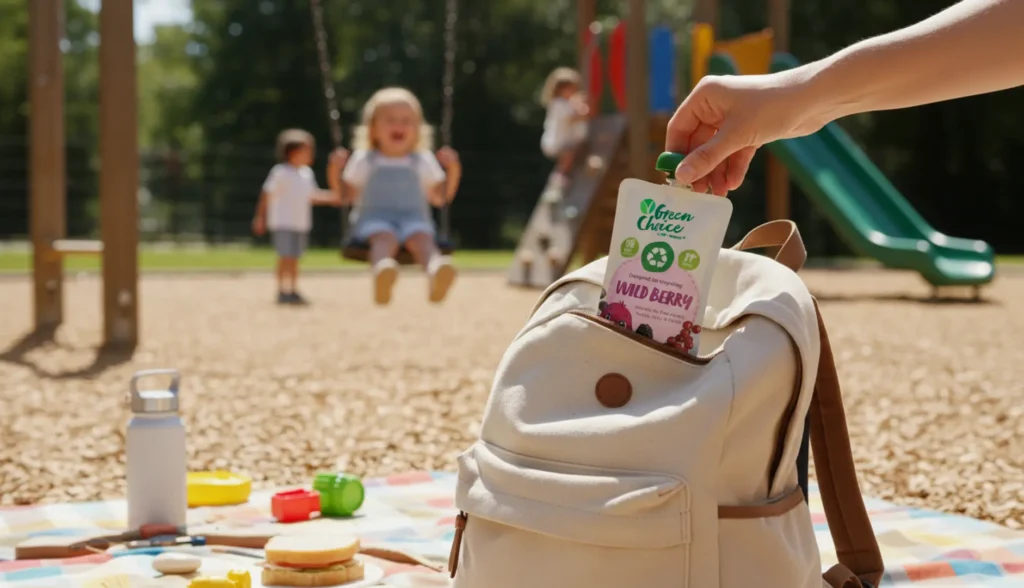
Today’s parents are always on the move. Packaging needs to travel easily, fit seamlessly into daily routines and support feeding anytime, anywhere. Lightweight, compact pouches make baby food easy to carry, easy to store and easy to use beyond the kitchen.
By balancing convenience, safety, efficiency and sustainability, we help brands deliver packaging that parents trust without having to think about it.
Because when packaging works well, it becomes invisible. And that is exactly what parents want.
Frequently asked questions about baby food pouches
Q: Do pouches support clean label baby food
A: High barrier pouch structures support thermal and non-thermal processing without preservatives.
Q: Are baby food pouches safe for all ages
A: Yes. Pouches are designed with no sharp edges and controlled dispensing. Pouring into a spoon remains recommended for infants.
Q: Are pouches more sustainable than glass jars
A: In most life cycle assessments, pouches show significantly lower carbon footprint due to reduced material and transport weight.
Q: Can pouches be recycled
A: Mono material pouches designed for recycling are increasingly available depending on local infrastructure.