From carbon neutral to climate aligned

Why we are raising the bar on climate action
For years, we set ourselves a clear ambition. To become a company carbon neutral organisation.
And we delivered.
By the end of 2025, we achieved company carbon neutrality, covering our Scope 1 and Scope 2 emissions, as well as selected Scope 3 activities such as business travel, company cars and operational waste. Any remaining unavoidable emissions were responsibly offset via financial climate contribution (Climate Partner , Climate ID 12374-2304-1001).
This was not symbolic. It was backed by hard work, data and real reductions across our operations.
It is worth pausing to acknowledge that achievement.
Because it mattered. And it still does.
What company carbon neutrality meant for us
Carbon neutrality was an important milestone in our sustainability journey.
It reflected years of focused effort to reduce emissions where we have direct control, including:
- A large scale transition across our sites, to electricity from sustainable sources contributing to a reduction in greenhouse gas emissions associated with purchased electricity.
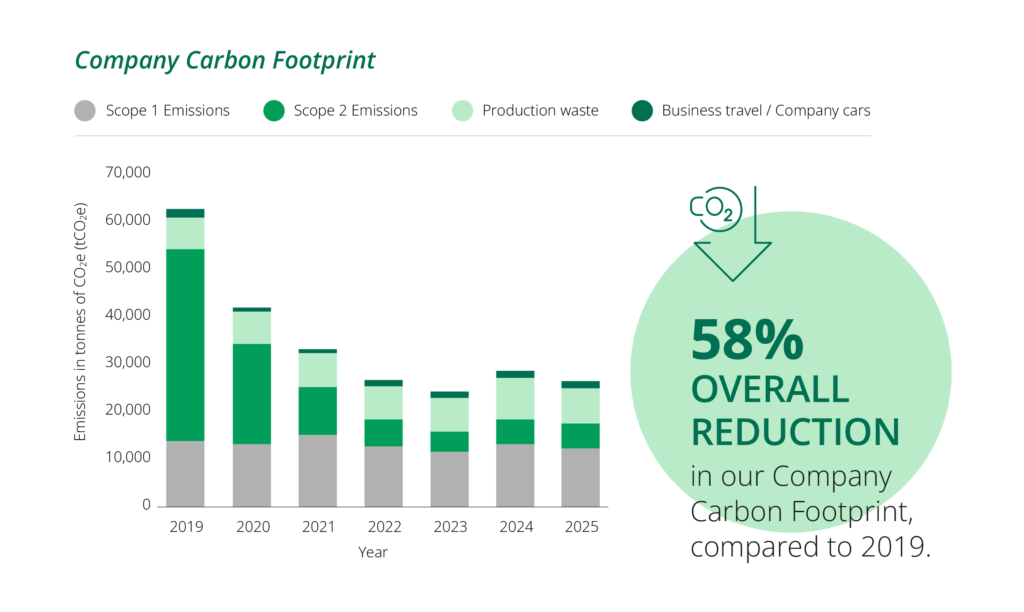
- Significant reductions in Scope 1 and Scope 2 emissions since 2019
- Continuous improvement in energy efficiency and waste reduction
- More responsible approaches to business travel and company vehicles
Since 2019, our operational carbon footprint (including scope 1 and 2) was reduced by 67%. By 2022, our operations were already carbon neutral, compensating remaining unavoidable emissions via financial climate contribution.
When we reached company carbon neutrality in 2025, we were proud. And rightly so.
But sustainability does not stand still. And neither do we.
Why transformation matters more than compensation
Carbon neutrality achieved through financial climate contribution has played an important role in climate action. But it also has clear limitations.
It focuses on balancing emissions rather than transforming the systems that create them. It does not fully reflect where the biggest impact sits across our value chain.
For us, the data is clear.
- Around 95% of our total emissions sit in Scope 3
- The largest share comes from raw material production, especially resins
- Real impact lies in reducing emissions at source, not just compensating for them
Making a financial climate contribution helped us take responsibility for our impact. But it does not replace the need for deep, absolute emissions reductions.
That is why we are deliberately moving forward.
Not away from responsibility. But towards accountability, transparency and science-based action.
From neutral to aligned with climate science
Our next chapter is about alignment. With climate science. With our value chain. And with long term credibility.
We are now aligning our sustainability strategy with the Science Based Targets initiative (SBTi)
This shift means:
- Clear, measurable emissions reduction targets in line with a 1.5°C pathway
- A stronger focus on absolute emissions reductions, across all scopes
- Increased engagement with suppliers to improve data quality and drive change
- Less reliance on financial climate contributions, and more focus on transformation
SBTi challenges us to tackle the hard part. Scope 3. Raw materials. Product design. Supplier collaboration.
That is where real change happens.
What comes next on our journey
Our Horizon 2030 strategy sets a clear direction for the years ahead.
We are committed to:
- Further reducing Scope 1 and Scope 2 emissions across our operations
- Cutting product related carbon footprint as part of our portfolio transformation
- Expanding our GreenChoice by Wipak® solutions using lower carbon materials
- Working closely with suppliers to improve data, transparency and joint reductions
This is a more demanding path. It requires better data, longer timelines and deeper collaboration.
It is also the right one.
Because sustainability is not about reaching a label and stopping there. It is about progress that holds up under scrutiny.
Celebrating progress. Choosing integrity.
We will always acknowledge the progress we make. Achieving company carbon neutrality was a defining milestone for Wipak.
But climate leadership means knowing when to move on.
Moving beyond making financial climate contributions is not a step back. It is a step forward. Towards climate action that is measurable, science based and built for the long term.
This is how we lead responsibly.
This is how we build trust.
And this is how we keep raising the bar.