Expert Advice: The 5 Questions Every Cheese Producer Should Ask Before Changing Packaging
Changing cheese packaging sounds simple.
In reality, it is one of the most complex decisions a food producer can make.
Whether you are launching a new product, changing pack formats, responding to retailer requests, improving sustainability credentials or preparing for the Packaging and Packaging Waste Regulation (PPWR), every packaging decision has implications for shelf life, operational efficiency, product quality and consumer satisfaction.
At Wipak, we work with cheese producers across Europe every day, helping them navigate these challenges. Through decades of experience, we have learned that the best packaging projects always start with the right questions.
To help you evaluate your next packaging project, Keith Gater, GreenChoice by Wipak® Product Manager, shares the five questions every cheese producer should ask before making a change.
1. What Type of Cheese Are You Packaging?
The first question might seem obvious, but it is often where the most important decisions begin.
Not all cheeses behave the same way, and packaging requirements vary significantly depending on the product itself. Some cheeses continue to release carbon dioxide during their shelf-life, while others remain relatively stable. Some require higher oxygen barriers, while others need packaging that can carefully manage gas transmission and internal pressure.
As Keith explains:
“The requirements for a grated cheese packaging film for a gassing cheese are different from the requirements for a grated cheese packaging film for a non-gassing cheese.”
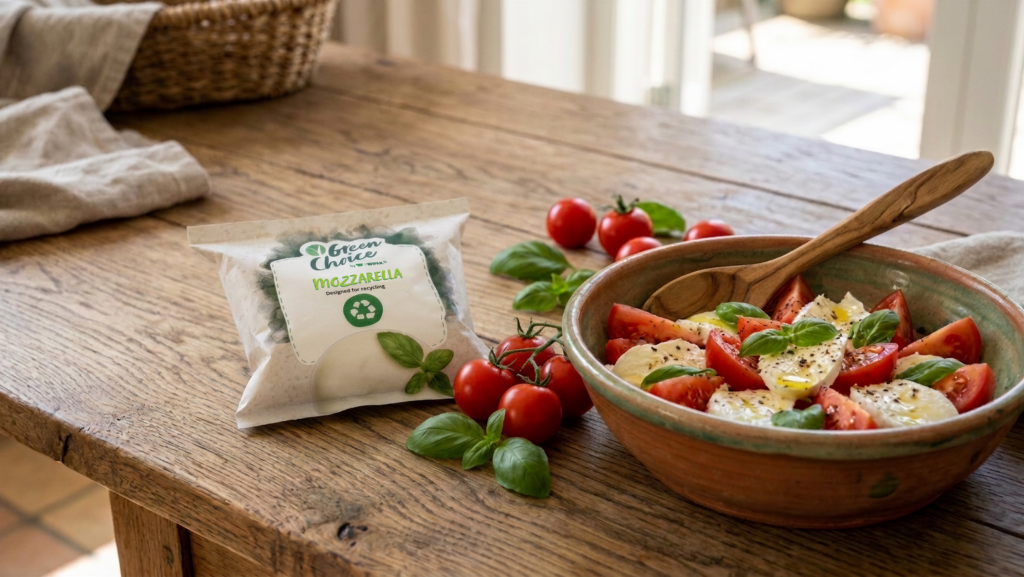
For example, grated Emmental may require very different packaging structures than a non-gassing cheddar. Fresh mozzarella creates another entirely different set of challenges, requiring packaging which protects against oxygen ingress, preserves moisture levels and maintains seal integrity despite contact with liquid brine. Packaging decisions also influence the type of modified atmosphere used and how effectively the package controls oxygen and carbon dioxide throughout shelf-life.
Before selecting a material, we need to understand the cheese.
2. What Are You Trying to Achieve?
Many producers approach us looking for a new packaging specification. However, the specification itself is rarely the real objective.
More often, the goal is one of the following:
- Improve recyclability
- Prepare for PPWR
- Reduce packaging complexity
- Lower material usage
- Improve operational efficiency
- Change pack format
- Reducing headspace
- Extend shelf-life
- Introduce a new product to market
The reason behind the change matters because it influences every technical decision that follows.
A producer moving from block cheese to grated cheese will face different challenges than a producer trying to replace a multi material structure with a recyclable mono material alternative. Similarly, a retailer driven sustainability initiative may require a different approach than a cost reduction project.
Understanding the desired outcome helps ensure the packaging solution supports the wider business objective.
3. Will the New Packaging Deliver the Shelf-Life You Need?
There is no sustainability without product protection.
Research shows that 41% of consumers value longer shelf-life for dairy products*, making freshness one of the most important performance requirements for cheese packaging.
Achieving that shelf-life depends on selecting the correct barrier properties for the application.
Mozzarella packaging, for example, must:
- Prevent oxygen ingress
- Minimise moisture loss
- Support modified atmosphere packaging
- Withstand liquid handling
- Maintain reliable seals even in challenging production conditions
Grated cheese applications require a different balance of oxygen barrier, moisture control and gas management, particularly when packaging gassing cheese varieties.
A common misconception is that sustainability upgrades can simply replace existing materials without affecting performance. In practice, every change should be validated to ensure shelf-life requirements continue to be met.
4. Are You Thinking About Today’s Requirements or Tomorrow’s?
Packaging decisions made today will still be affecting your business years from now.
That is why PPWR is becoming a key consideration in almost every customer conversation.
According to Keith, one of the most common questions he receives today is:
“Which recyclable specifications do you have?”
Increasingly, producers are looking beyond immediate packaging requirements and evaluating how their packaging portfolio aligns with future legislation and retailer expectations.
The PPWR is driving a shift towards packaging designed for recycling, increased use of recycled content, reduced packaging complexity and greater compliance reporting requirements. By 2030, packaging placed on the European market will need to meet increasingly demanding recyclability criteria.
The producers that start preparing now will have greater flexibility and fewer disruptions as these requirements come into force.
5. Have You Allowed Enough Time for Validation?
This may be the most overlooked question of all.
Many packaging changes affect far more than the pack itself. Even a seemingly small modification can require extensive testing to confirm product performance throughout its shelf life.
Changes to the cheese recipe, packaging format or packaging material can all trigger validation requirements.
As Keith explains:
“Changing the product inside or changing the material specification requires shelf-life validation. One round of shelf-life testing can take three months, and normally multiple rounds are needed.”
For many cheese applications, a complete packaging transition can take twelve months or longer from initial concept to commercial implementation.
The earlier these projects begin, the smoother the transition is likely to be.
How GreenChoice Supports the Transition
The good news is that cheese producers do not need to choose between sustainability and performance.
GreenChoice was developed to help food producers navigate evolving market expectations, retailer demands and regulatory requirements while maintaining the performance their products depend on.
Our GreenChoice portfolio includes solutions designed for recycling, solutions incorporating recycled content and solutions based on renewable raw materials. These solutions are developed with the realities of cheese packaging in mind, including shelf-life requirements, sealing performance, machinability and consumer convenience.
Today, around 90% of customer applications across Wipak can already be served with a GreenChoice solution.
The Bottom Line
Successful cheese packaging starts long before a material is selected.
It starts with understanding the product, the production process, consumer expectations and future regulatory requirements.
Whether you are introducing a new cheese product, changing pack formats, improving recyclability or preparing for PPWR, asking the right questions early can save significant time, cost and complexity later.
That is where experience matters.
At Wipak, we combine decades of cheese packaging expertise with a growing portfolio of GreenChoice solutions to help producers make confident packaging decisions today while preparing for the challenges of tomorrow.
Ready to discuss your next cheese packaging project?
Our specialists can help you evaluate packaging formats, shelf-life requirements, recyclability targets and PPWR readiness, ensuring your packaging performs as well tomorrow as it does today.
*Dairy products: Flexible packaging scores points for freshness and everyday suitability” November 2025 , Flexible Packaging Europe (FPE), media release.